A Queensland problem, and a Toowoomba one
QBCC describes termites as a problem throughout Queensland, and nowhere does that land harder than under a timber house on hardwood stumps. A Queenslander is a termite's ideal: timber posts set straight into the ground, a bearer resting on each, joists on the bearers, a timber floor and timber-framed walls above, and an enclosed subfloor that stays damp for weeks after a summer storm. The stump is the bridge from the soil to everything else. Once a colony is up it, the bearer, the joists, the bottom plate and the wall studs are all within reach.
Toowoomba's housing makes this a city-wide issue rather than a rural one. The region had 73,881 dwellings at the 2021 census, 82.7 per cent of them separate houses, and the older suburbs, Newtown from 1865, East Toowoomba from the 1870s, Harristown from 1902 and 1910, are full of timber homes that have stood on posts in the ground for most of a century. Many have been restumped once already, and some of those restumps were timber again. The signs page lists what termite damage looks like from inside; this page is about the rules and what a restump changes.
What the rules require
Two things, and both are easy to check. The Building Code of Australia requires a termite management notice to be fixed in the meter box of a house where a termite management system has been installed. The notice records the system, the date and the inspection schedule. The National Construction Code's Queensland variation to H1 requires termite management for new building work with a design life of 50 years, which is why a new house, a raise, a build-under or a new set of stumps has to be protected in a way that lasts, not with a spray that wears off. QBCC recommends an inspection at least once a year, and chemical termite management is a QBCC occupational licence regardless of the value of the job.
The reason the Code puts the notice in the meter box is that it is the one place every tradesperson, inspector and buyer opens. It is the house's own record of what has been done to protect it, and a yearly inspection should add a line to that record. A pest inspector who finds no notice has to assume there is no system, and prices the inspection and the treatment accordingly.
Open your own meter box. If there is a notice, read the date. If there is no notice on a house with a new extension, a raise or a recent restump, something was missed. On an untouched old Queenslander there may never have been one, which tells you the house has been relying on luck and the pest inspector.
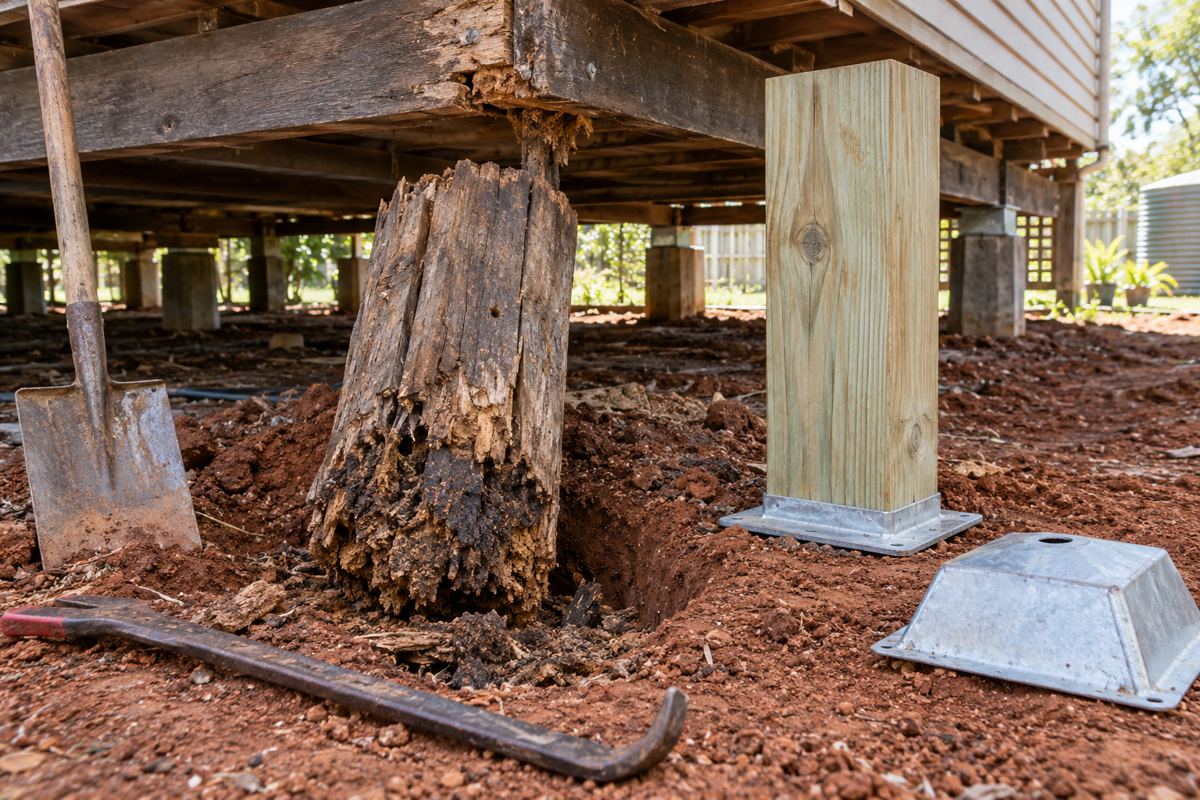
How termites use a stump
Subterranean termites live in the ground and need moisture. They reach timber either by travelling inside it from where it touches the soil, or by building mud tubes up a surface to bridge a gap. A hardwood stump in the ground gives them the first route: in at the ground line, up through the heart of the post, and out into the bearer without ever showing on the surface. A concrete or steel stump takes that route away, which is why they build tubes up the outside instead, and why the ant cap exists.
| What the inspector looks for | What it means |
|---|---|
| Mud tubes up a stump, a pier or the inside of a brick base wall | Active or recent termite travel from the ground to the timber above. Follow the tube to find what they reached. |
| Hardwood stump that sounds hollow or takes a screwdriver at the ground line | Internal galleries, rot, or both. The stump is replaced and the bearer above it is checked. |
| Ant caps missing, rusted through, or bridged by packing | The barrier that forces termites into the open has gone. Packing timber on top of a cap defeats it. |
| Damp soil, pooling water, a leaking shower waste, a downpipe under the house | Moisture, which is what the colony needs. Fix the water before the timber. |
| Timber in contact with the ground: stored timber, formwork left behind, a garden bed against the base wall | A bridge straight into the house. Clear it. |
| Bearer or joist that sounds dull when tapped, or a floor that gives | Timber eaten from the inside. Replaced while the house is on jacks. |
| Blistered paint, bubbling plaster, a skirting that crumbles | They are already in the walls. Pest controller before anything else. |
What a restump changes
A restump onto concrete or galvanised steel stumps removes the timber-in-ground route entirely. There is no post for termites to travel inside, so they have to come up the outside, where a correctly fitted ant cap forces them into the open and a torch finds the tube. That is the single largest improvement a Queenslander can be given against termites, and it is why the stump types page treats timber as the choice of last resort here. A full restump also puts the house up on jacks, which is the moment to replace any bearer or joist the termites reached, and to regrade and drain the subfloor so it stops being damp.
Where only a few stumps are replaced, the same applies to those few, and the rest of the subfloor keeps whatever risk it had. A partial job on a house that still has forty hardwood stumps in the ground has not solved the termite problem; it has solved four of them. Where the stumps are replaced with treated timber, which happens on some heritage jobs and some budgets, the new timber resists attack better than the old hardwood did but still touches the ground, and the ant cap and the yearly inspection matter more, not less.
What a restump does not change
It does not remove a colony. If termites are active in the house, a licensed pest controller treats them first, and the restumper replaces what they ate second. Doing it the other way round means new stumps under timber that is still being eaten. It does not remove the moisture that attracted them: that is the downpipe, the leaking waste, the blocked vents and the grade under the house, which the soils and drainage guide goes through. It does not protect the walls above: the bottom plates, studs and window frames are still timber, and termites that reach them by another route, a tree against the house or a timber step, will eat them as before. And it does not replace the yearly inspection. QBCC's recommendation is a check at least once a year, and on a timber house in Toowoomba that is the cheapest insurance there is.
The sequence that works
- Pest inspection. A licensed inspector goes under the house, follows any tubes, taps the bearers and the bottom plates, and reports what is active and what is old damage.
- Treatment if needed. Chemical termite management is a QBCC occupational licence; the pest controller is the licensed person, not the restumper.
- Restumper's inspection. Every stump probed, every bearer sighted, the damaged timber listed, the ground noted. See the cost guide for what the quote should name.
- The restump. Concrete or steel stumps with ant caps, damaged bearers and joists replaced while the house is on jacks, the subfloor regraded and drained, a certifier's permit where the job is a full restump.
- The notice. Where a termite management system is installed with the work, the notice goes in the meter box with the date.
- Every year after. An inspection. The new stumps have taken away the hidden route; the yearly check covers the visible one.
Buyers and landlords
If you are buying, the buying guide says to get the pest inspection with the building inspection and to read the meter box notice before the contract goes unconditional. If you are a landlord, 38.4 per cent of dwellings in the Toowoomba urban centre were rented at the 2021 census, and a tenanted Queenslander is a house nobody looks under. A yearly inspection on a rental is a small line against the cost of a bearer, a wall and a floor.
What this page cannot do
It cannot tell you whether your house has termites. Only an inspection under the floor and along the walls does that, and a licensed pest inspector is the person to do it. It cannot treat them: chemical termite management is a QBCC occupational licence held by pest controllers, not restumpers. It cannot tell you what the meter box notice on a particular house should say, because that depends on the system installed and when. And it cannot say that new concrete or steel stumps make a house termite-proof; they remove the hidden route through the post, and a yearly inspection covers the rest. Where the Building Code and the NCC Queensland variation apply to your job, the certifier confirms what is required.
Check the current rules before you rely on this
This page describes how termites affect stumps and subfloor timber in Toowoomba and what the building rules require. It describes the rules in general terms as they stood in October 2026. Standards, forms, thresholds and fines change.
The authoritative sources are QBCC on termites in Queensland, NCC 2022 Volume Two, Queensland variation H1 (termite management), QBCC, when you need a licence, ABS 2021 Census QuickStats, Toowoomba (R) and ABS 2021 Census QuickStats, Toowoomba urban centre. Where anything here differs from those sources, they are right and we are not.
We are not building certifiers, engineers, planners or lawyers. For what applies to your house, ask a licensed building certifier or ring Toowoomba Regional Council on 131 872.
Accurate at the time of writing, October 2026. Always check the source before relying on it.