The north-west and the north
Wilsonton is a post-war suburb on the north-western side of the city, and with Wilsonton Heights, Rockville, Cranley and Harlaxton it makes up the belt of housing between the city centre and the airport. Highfields, Cabarlah and Crows Nest sit up the Range to the north on the road toward the Bunya country; this site has not verified when they were built, so it describes them as surrounding towns with older centres and newer estates, and leaves the dates out. What is verified is that the region is growing: the Queensland Government Statistician's Office put Toowoomba's population at 186,276 at 30 June 2025, up 2,201 in a year, the eighth largest local government area in Queensland, and a good share of that growth is in the north.
For a restumper the north splits in two. Wilsonton and its neighbours are post-war timber and fibro houses on stumps, high-set and low-set, with the first generation of hardwood stumps long gone and a second generation of concrete under many of them. Highfields and the northern estates are mostly newer brick on slabs, where the work, when there is any, is underpinning a footing on reactive ground rather than stumps, with a scatter of older timber houses in the town centres and on the acreage blocks that were there before the estates.
Two soils, again
The north has both of Toowoomba's soils. The higher ground up the Range toward Highfields is largely the red volcanic soil weathered from the basalt of the Main Range Volcanics, the well-drained ferrosol the Queensland Government describes along the Great Dividing Range. The lower, flatter ground toward the airport and west of it grades into the black cracking clay of the Downs. The Bureau of Meteorology's Toowoomba Airport station, recording since 1996, averages 740.1 mm of rain a year against the city station's 952.4 mm, with December the wettest month at 103.5 mm; the lower ground is drier as well as flatter, and in spring 2019 the airport recorded 23.8 mm for the whole season against an average of 169.6 mm, the driest spring on record on the Darling Downs. Clay that dry shrinks away from the stumps.
Which soil a given house in Wilsonton stands on is a question for the soil test, not the suburb name, and the soils guide explains why the two behave differently. The practical difference for a restump: on the red soil the holes dig cleanly and the ground moves little; on the clay the holes go deeper, an engineer may classify the site, and the drainage work that keeps the moisture even is what protects the new stumps.
| Area | Housing | Typical work |
|---|---|---|
| Wilsonton, Wilsonton Heights, Rockville | Post-war timber and fibro on stumps, high-set and low-set; many restumped once on concrete | Full and partial restumps, relevelling on sound concrete stumps, bearer and joist repairs, steel stumps where the owner wants adjustability |
| Cranley, Harlaxton, toward the airport | Post-war and later; flatter ground grading to clay | Restumping and relevelling; drainage on the clay |
| Highfields, Cabarlah, the northern estates | Newer brick on slabs with older timber houses in the centres and on acreage; not dated by this site | Underpinning on reactive ground; restumping the older timber houses |
| Crows Nest and the north | Older town centre, surrounding rural blocks; not dated by this site | Restumping older timber homes; distance and access shape the job |
Steel stumps in the north
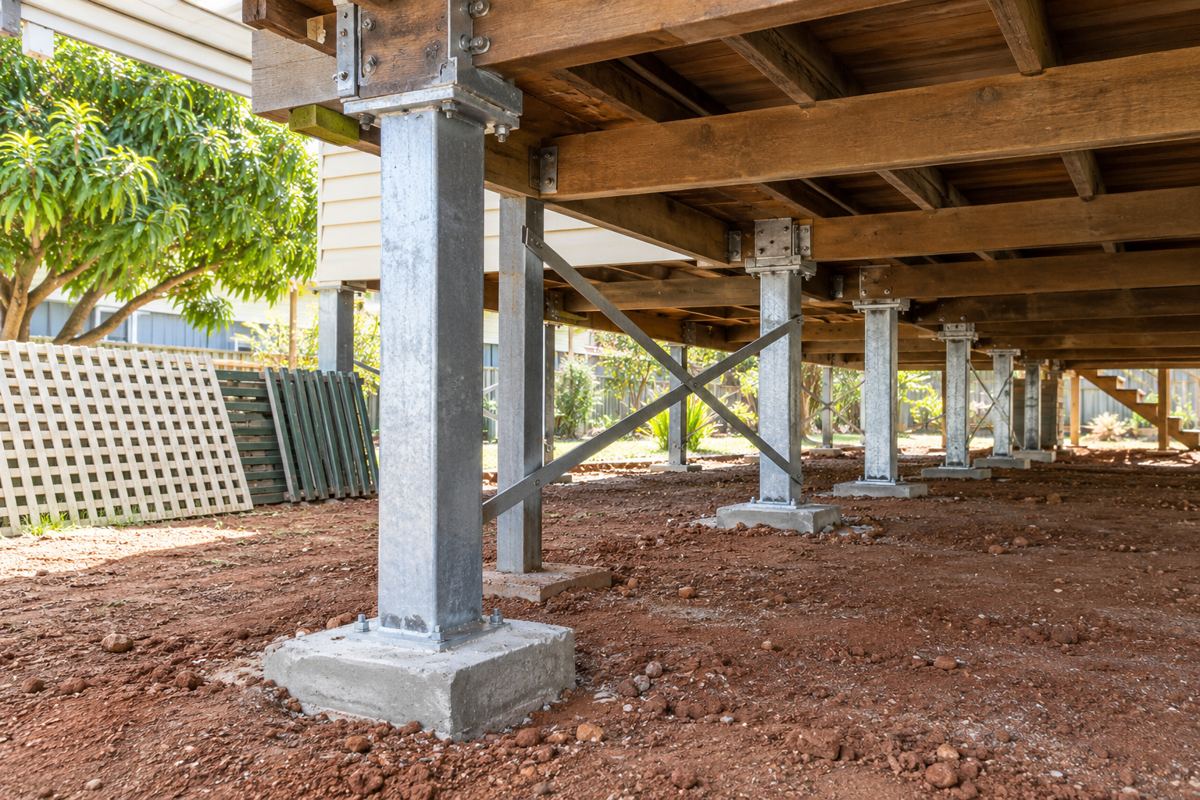
Wilsonton's post-war houses are where adjustable galvanised steel stumps make the most sense in Toowoomba. A house that has already been restumped once on concrete and has settled unevenly again on the clay can be put on steel stumps with threaded top plates that are relevelled later with a spanner, without jacks and packers. Steel also takes away the timber-in-ground route that termites use, which QBCC calls a problem throughout Queensland, and with cross-bracing it carries a high-set house well. It costs more per stump than precast concrete, and the stump types page weighs the two for clay, red soil and termites. On the red soil up the Range, where the ground moves less, concrete is usually enough.
Relevelling and partial jobs on a second set of stumps
Because so much of Wilsonton has been restumped once already, the most common call from the north-west is not a full restump but a house on concrete stumps that has gone out of level again. The first thing to settle is whether the stumps are the problem. If they are sound, standing plumb and sitting on footings that have held, the house has simply settled unevenly on the clay and the job is relevelling: jacks under the bearers, steel packers on the stump tops, a level along each bearer, no digging and no permit question beyond asking the certifier. If a few have cracked, tilted or sunk, it is a partial job replacing those while the rest are packed. If the earlier restump was a mix and the hardwood that was left is now failing, the honest answer is often the full restump the previous owner avoided.
The other thing a second-generation restump hides is what was done to the bearers at the time. A concrete stump set under a bearer that was already soft carries a bearer that is now worse, and a floor that gives between two firm points is the sign of it. On a low-set post-war house in Rockville or Wilsonton Heights that bearer is found when the house is on jacks and not before, which is why the quote should carry a rate for timber found rather than a promise that there is none.
The airport environs overlay
One overlay matters more in the north-west than anywhere else in the city. Council's list of overlays in the Toowoomba Regional Planning Scheme 2012 includes airport environs, which controls height near the airport. A restump at the existing height does not change the height of the house and is not usually affected. A raise near the airport can be, and the certifier checks it. The mapping at maps.tr.qld.gov.au shows whether a block is under the overlay, and the overlays page lists the others, including bushfire, which runs along the Range bush toward Highfields and Crows Nest, and the agricultural land and water resource catchment overlays that a block on the edge of a northern town can sit under.
Approvals, licences and distance
The rules are the same across the region. A full restump, any underpinning and any raise is assessable building work under the Building Act 1975 needing a building development permit from a licensed building certifier; replacing a few stumps may be accepted development, Logan City Council's fact sheet puts the line at 20 per cent of the structural components, and the certifier decides. Toowoomba Regional Council's building certification team certifies on 4688 6828 alongside private certifiers, and the same council covers Highfields and Crows Nest, so a duty certifier at the Toowoomba Service Centre on a Tuesday or Thursday is the right person for a Highfields question too. Over $3,300 the builder needs a QBCC licence in a class that covers house work, Builder Low Rise or higher, and the Queensland Home Warranty Scheme covers the job. The approvals page has the detail.
What changes in the north is distance. A job in Crows Nest or on acreage past Highfields is further from the yard, the certifier and the concrete supplier than a job in Wilsonton, and a quote may reflect that in travel and in how the inspections are scheduled. The cost guide says what a quote should name; on a rural block it should also say who removes the old stumps and spoil, because there may be no kerbside collection.
Before you ring
For a post-war house in Wilsonton, look under it. If it is high-set, walk under with a torch and a screwdriver and probe each stump at the ground line; if it is low-set, look through the vents and the access hatch. Note whether the stumps are hardwood, concrete, steel or a mix, which tells you whether the house has been done before. Inside, walk the signs page checklist. Outside, look where the downpipes go and whether the ground is red or black. For a brick house in Highfields with stepped cracks, photograph the cracks with a coin for scale, because that is an underpinning question and the first call is an engineer. Then send the photos with the town and the house type.
What this page cannot do
It cannot date Highfields, Cabarlah, Crows Nest or the northern estates, because this site has not verified when they were built; it describes them only as surrounding towns with older centres and newer estates. It cannot say what soil is under a given house, because the north grades from red soil on the Range to black clay toward the airport within a few kilometres and sometimes within a block; only a soil test classifies a site. It cannot say whether a block sits under the airport environs, bushfire, agricultural land or catchment overlays; the mapping at maps.tr.qld.gov.au and council's planning team on 131 872 do. And it cannot say whether your job needs a permit; the certifier decides.
Check the current rules before you rely on this
This page describes restumping and related work in Wilsonton, Highfields and the suburbs and towns north of Toowoomba. It describes the rules in general terms as they stood in October 2026. Standards, forms, thresholds and fines change.
The authoritative sources are Queensland Places, Wilsonton, Queensland Government Statistician, population growth in regional Queensland 2024-25, Bureau of Meteorology climate statistics, Toowoomba Airport, Bureau of Meteorology, Queensland in spring 2019, Toowoomba Regional Council, planning scheme zones and overlays and Toowoomba Regional Council, building certifiers. Where anything here differs from those sources, they are right and we are not.
We are not building certifiers, engineers, planners or lawyers. For what applies to your house, ask a licensed building certifier or ring Toowoomba Regional Council on 131 872.
Accurate at the time of writing, October 2026. Always check the source before relying on it.