The signs, in the order they usually appear
A house on stumps fails in a sequence. One stump rots at the ground line or drops on moving clay, the bearer it carried sags, the floor above tilts, and the walls standing on that floor go out of square. The signs inside the house follow the same order, which is why one of them on its own is a hint and three together in the same corner is a reason to get under the house with a torch. Toowoomba's housing is mostly timber on stumps: the ABS counted 73,881 dwellings in the region in 2021, 82.7 per cent of them separate houses, and a large share of the older ones are high-set or low-set Queenslanders and post-war timber homes with the whole house carried on posts in the ground.
- A door that catches or swings. A bedroom door that latched cleanly last autumn now rubs at the top corner, or drifts closed on its own. The frame has gone out of square because the floor under one side has dropped. Look for a door that has been planed along the top edge: someone has already noticed and fixed the symptom.
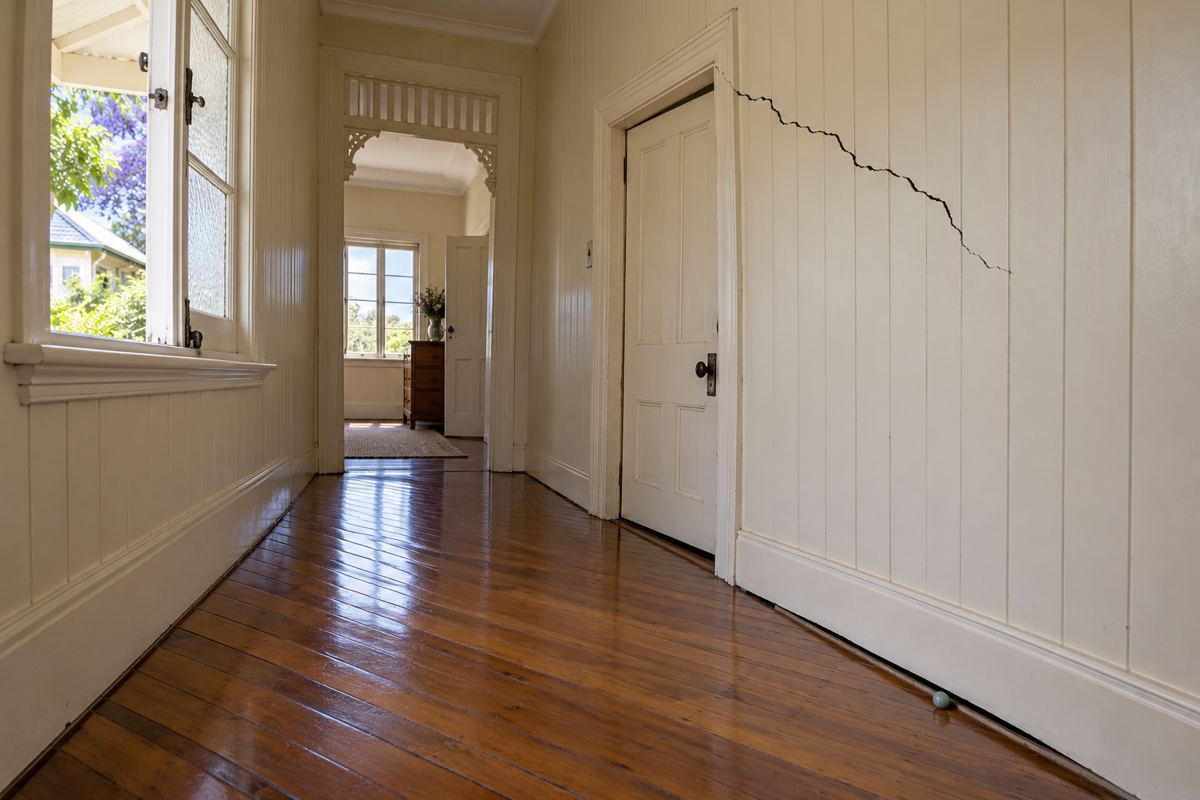
- A floor that runs downhill to one wall. A marble put down in the hallway rolls to the same skirting every time. In a Queenslander the low side is often the wet side under the bathroom and laundry, or the side where the downpipe discharges onto the ground.
- Diagonal cracks from the corners of doors and windows. In a VJ-lined house the crack runs through the boards or opens the joints on a diagonal. In a plastered post-war house it runs from the top corner of the frame up toward the cornice. On the black clay these can open in a dry winter and close after summer storms. Where a stump has gone, they open and stay open.
- A gap under the skirting. The skirting is nailed to the wall and stays put while the floor drops away from it. A dark line, or daylight, under a skirting means the floor has gone down, and a floor only goes down when what carries it has.
- A bouncy or dipped patch between two firm points. If the floor gives underfoot in the middle of a room but is solid at the walls, that is usually a bearer or a joist that has rotted or been eaten, not a stump. See bearer and joist repairs.
- Stepped cracks in brickwork outside. On a brick veneer on stumps a stump under that corner has dropped. On a brick house on a slab or a strip footing the footing has moved on the clay, and that is underpinning rather than restumping.
- Windows that no longer close square. Timber sashes that jam on one side, casements that will not latch, or aluminium sliders that have to be lifted to lock.
- Lattice, battens or base boards pulling away. On a high-set house the skirt of lattice or boards around the under-house is fixed to the stumps. When it buckles, gaps at the corners or pops its nails, the stumps behind it have moved.
What it looks like under the house
The signs inside say the house has moved. The subfloor says why. An hour under the floor with a torch, a probe, a long level and a moisture meter settles whether the job is a full restump, a handful of stumps, relevelling on stumps that are still sound, bearers, or drainage. On a high-set Queenslander you can walk under and see most of it. On a low-set post-war house it is a crawl.
| Under the house | What it usually means |
|---|---|
| Timber stump soft or hollow at the ground line when probed | Rot. The stump is replaced. Hardwood stumps rot where they meet damp soil, and the black clay holds water against them after a storm. |
| Stump leaning, bearer no longer sitting square on it | The ground has moved, or the stump was never deep enough for the clay it is in. Common where a garden bed or a downpipe keeps one side wetter than the other. |
| Stumps standing in wide dry cracks in the soil | Cracking clay in a dry spell. The ground has shrunk away from the stump and will swell back after rain. The house moves with it every year. |
| Mud tubes up a stump, galleries in the timber | Termites. QBCC says they are a problem throughout Queensland. Pest controller first, then replacement. See the termites page. |
| Stack of timber, brick or fibro packing between stump and bearer | The house has been relevelled before, cheaply. Packing that thick is a reason to probe the stump under it. |
| Crushed or mushroomed stump top under a bearer | An old stump has given way under load, or an ant cap has rusted through and the end grain has taken water. |
| Bearer soft above a stump, floor dipped overhead | Rotted bearer. Replaced while the house is up on jacks. |
| Stumps and bearers sound, floor still out of level | Settlement on the clay. Relevel on the existing stumps, no digging. |
| Brick piers cracked, strip footing showing | Footings moving. Underpinning on an engineer's design, not stumps. |
Why Toowoomba houses show these signs
Four local reasons, and most houses in the city have at least two of them.
Two soils that both move. The city sits on the basalts of the Main Range Volcanics. Where that rock has weathered on the Range it leaves the red volcanic soil the Queensland Government classes as ferrosol, well drained and kind to timber. Out on the Downs and in the lower parts of town the soil is a vertosol, the black cracking clay that the same source calls the most common soil in Queensland. Clay swells when it is wet and shrinks when it dries, and a house on it rises and falls a little every year. The soils guide goes through both.
A summer-wet, winter-dry climate. The Bureau of Meteorology's Toowoomba city station averaged 952.4 mm of rain a year between 1869 and 2007, with January the wettest month at 132.1 mm, while July is cool and dry. That pattern is exactly what reactive clay dislikes: a soaking from summer storms, then months of drying. The spring of 2019 was the driest on record on the Darling Downs, and cracks that opened in houses that year are the clay shrinking away from the stumps.
Termites. QBCC describes termites as a problem throughout Queensland and recommends a yearly inspection. In an old hardwood stump the damage can be inside while the outside looks fine, and the bearer above can be going too. The termites page covers the meter box notice and what a restump changes.
Age. Newtown was subdivided in 1865, East Toowoomba grew around Queens Park from 1869, Harristown was cut up in 1902 and 1910, and the post-war suburbs filled in after that. A hardwood stump set in the ground when a house was built eighty or a hundred years ago has done well to last, and many have already been replaced once, sometimes with whatever was to hand.
What to do before you ring anyone
Walk the house with a notebook. Open every internal door and note which ones catch and on which corner. Put a marble down in the hallway and in the lowest room and watch where it goes. Look along the skirting in that room with a torch held flat against the floor. Then go outside and look at the base of the house on each side: lattice that has buckled, weatherboards that have bowed out at the bottom, a brick pier with a crack, a stump visible through the battens that is leaning or dark with damp, a downpipe that ends on the ground.
Take photos. The lowest room from the doorway, the worst crack with a coin beside it for scale, the base of the house on each side, and anything you can see under the floor. Photos from one season against the next are a better record of movement than memory, and on the clay they tell you whether the house is moving with the weather or has dropped and stayed down. Those same photos are what a restumper asks for first, because they usually settle whether the job is a relevel, a partial or a full restump before anyone drives out.
If you have a high-set house, go under it. Carry a torch and a screwdriver and push the point into each stump at the ground line. Sound hardwood resists. Rotted hardwood takes the point with no effort. Look up at the bearers above any stump that fails and tap them with the handle. A dull note is wet or eaten timber.
What an inspector looks for
A pre-purchase building inspector probes stumps at the ground line, notes heavy packing, looks for moisture staining and fungus, and checks the bearers at the wet-area corner. A pest inspector follows termite tubes up the stumps and taps the bearers. Either report can flag the stumps without counting them, which is why the buying guide says what to do with a report before settlement, and the cost guide says what a quote should name after the restumper's own inspection.
The restumper's inspection is different in one way that matters: it counts. Every stump is probed, every bearer is sighted along its length, and the ground at the base of each stump is noted as red soil, black clay or fill. The result is a number of stumps to replace, a view on the timber above them, and a recommendation on stump type, which on the clay and in a termite region is rarely timber again. Where the house is a brick home on a slab the inspection is a different one, looking at footings and cracks, and the answer is underpinning on an engineer's design rather than stumps.
What these signs cannot tell you
They cannot tell you how many stumps have gone, and the count is what the price depends on. They cannot tell you whether the bearers and joists above the stumps are sound, which on a damp low-set subfloor is the biggest unknown. They cannot separate, from inside, a dropped stump from a dropped footing under a brick veneer, or seasonal clay movement from a stump that has failed. And they cannot tell you whether the cause is still active: a shower that has been leaking into the subfloor for years, or a downpipe that soaks one corner after every storm, will rot the new timber as readily as the old. All of that is the inspection, with a torch, under the house.
Check the current rules before you rely on this
This page describes how subfloor problems show up in homes in Toowoomba and what they usually mean. It describes the rules in general terms as they stood in October 2026. Standards, forms, thresholds and fines change.
The authoritative sources are ABS 2021 Census QuickStats, Toowoomba (R), Queensland Government, soil types, Bureau of Meteorology climate statistics, Toowoomba (city), QBCC on termites in Queensland and Wikipedia, Toowoomba. Where anything here differs from those sources, they are right and we are not.
We are not building certifiers, engineers, planners or lawyers. For what applies to your house, ask a licensed building certifier or ring Toowoomba Regional Council on 131 872.
Accurate at the time of writing, October 2026. Always check the source before relying on it.