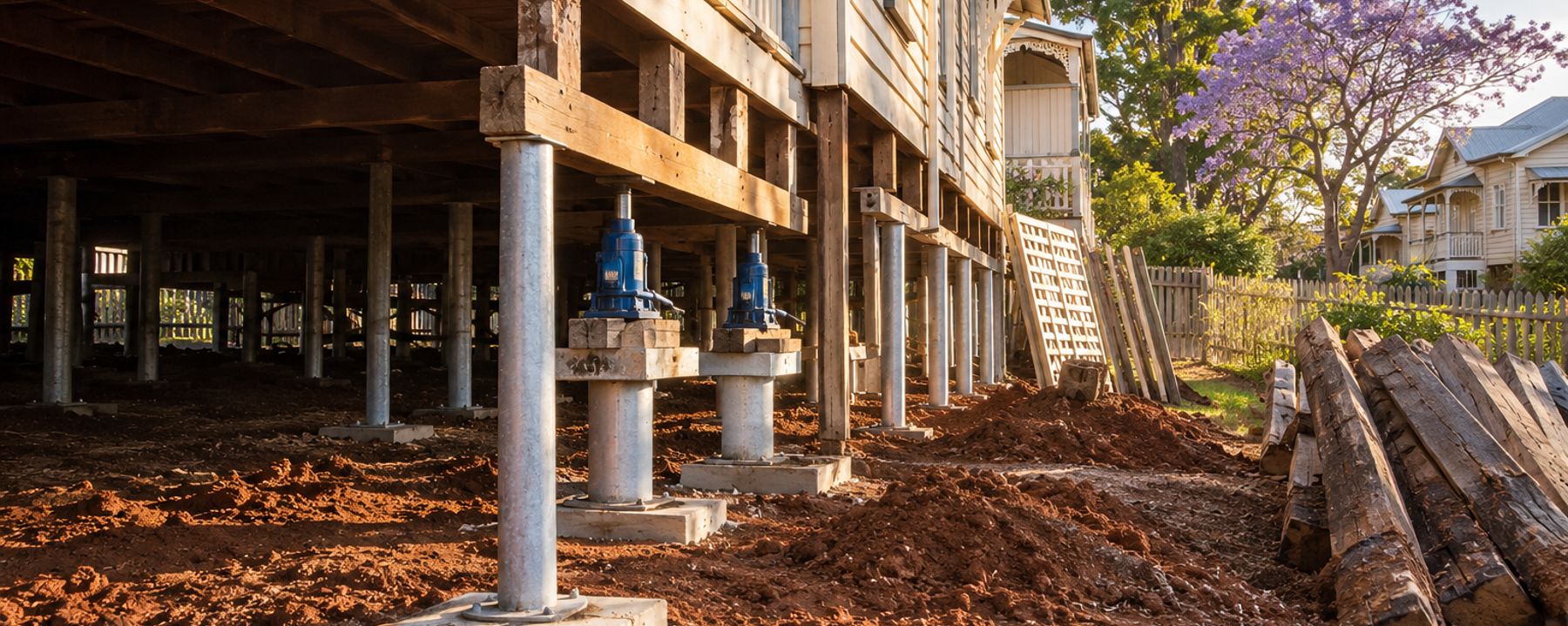
Restumping in Toowoomba for Queenslanders that have dropped at one corner.
Restumping, house raising, relevelling and underpinning for the high-set and low-set Queenslanders, post-war timber homes and brick veneers from Newtown and East Toowoomba out to Highfields, Drayton and the Downs.
QBCC-licensed local builders, a building approval from a licensed certifier where the job needs one, and stumps chosen for red volcanic soil, black cracking clay and a termite-prone region rather than whatever came off the truck.
Tell us what the house is doing
The suburb, what the house sits on if you know, and what you have noticed: a hallway that falls away toward the back verandah, a door that has to be lifted to shut, a crack through the VJ boards over the kitchen door that was not there before the storms. A photo of the worst room and one of the outside of the house is enough to begin with. Under a high-set Queenslander you can walk in with a torch, so a photo of a stump or two tells us most of the rest.
If a building or pest report has flagged the stumps, the house is being sold, a renovation is waiting on a level floor, or you are thinking about raising for a build-under, say so. It changes what gets lodged first and which trade needs to look first.
Request a quote
A Queenslander is only as level as the stump nobody has looked at since the last drought.
Toowoomba was founded in 1849, became a municipality in 1860, got its railway in 1867 and was declared a city in 1904, and the house it built across those decades was the timber Queenslander on stumps. Newtown was subdivided in 1865. The Caledonian Estate east of the CBD went up in classic timber Queenslander style. Harristown was subdivided in 1902 and 1910 and filled out after the war, and Rangeville, Wilsonton and Kearneys Spring followed with post-war timber homes and later brick veneers on slabs. At the 2021 census 82.7 per cent of the region's 73,881 dwellings were separate houses. A great many of the older ones still sit on hardwood stumps set into red volcanic soil on the Range or black cracking clay on the Downs, and those stumps have stood in it through a century of wet summers, dry winters and termites.
Eventually one rots through at ground level, or the termites hollow it, or the clay under it shrinks back in a dry winter and leaves it hanging. The bearer above it drops and the house follows: the floor tilts, the doors bind, a diagonal crack opens in the VJ boards above a door frame. Restumping replaces those stumps with concrete or galvanised steel and brings the floor back to level while it is done. In Queensland that is building work under section 5 of the Building Act 1975. A full restump, underpinning or any house raise needs a building development permit from a licensed building certifier, and Toowoomba Regional Council still certifies through its own team alongside the private certifiers. Over $3,300 the builder needs a QBCC licence in a class that covers it, which for a house is Builder Low Rise or higher.
The pages here cover both halves: the trade, and the rules that sit around it in this region.
Approvals, QBCC licences and contracts for restumping in Toowoomba, in plain English
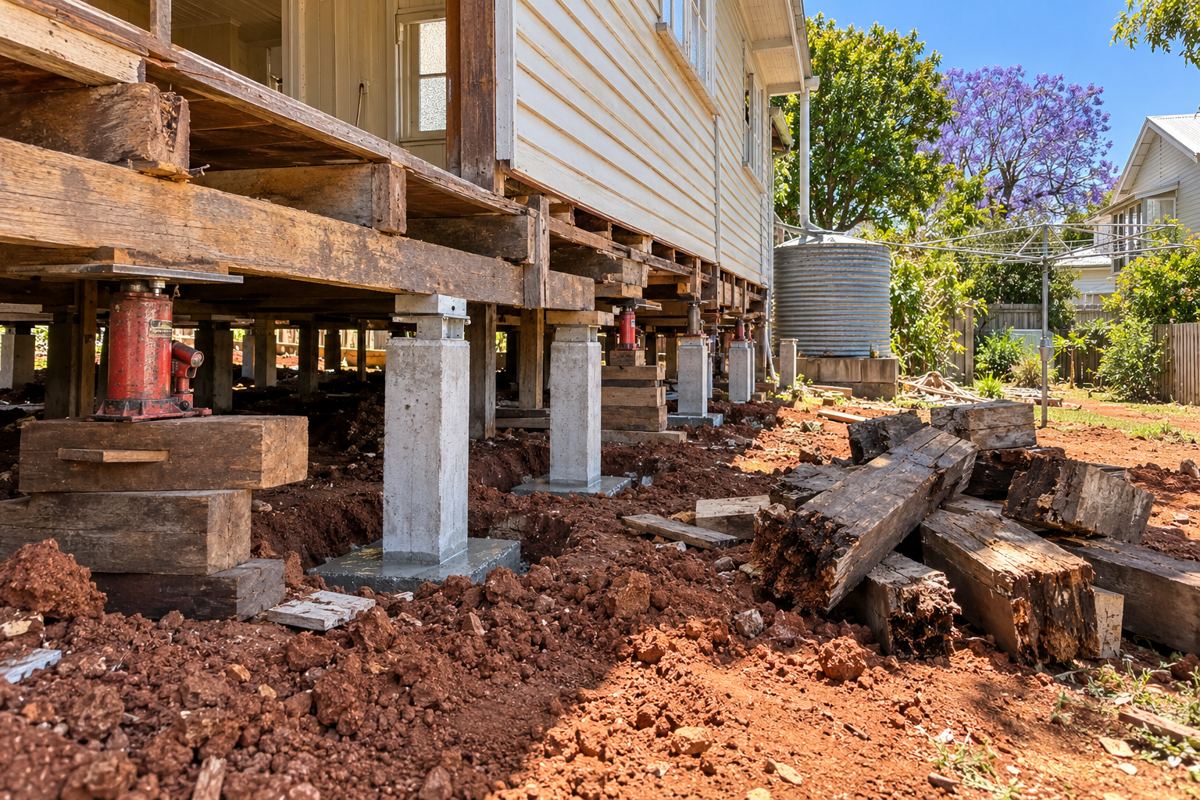
Eight ways a Toowoomba house asks for new stumps
Most of them show up inside long before anyone walks under the house with a torch, and many of them change with the seasons.
- The floor runs downhillA marble rolls to the same wall in every room. In a Newtown Queenslander the polished hallway tips toward the back of the house, where the old verandah was enclosed for a bathroom and the stumps carry a load they were never cut for.
- Doors that need a shoulderThe back door shut fine through winter and has to be lifted to close after the first run of summer storms. The frame has gone out of square because the clay under that corner has swelled and the stump beside it has not moved with it.
- Cracks at the corners of framesDiagonal cracks from the top corner of a door or window up through the VJ boards or the plaster. On the black clay south and west of the city they open through a dry winter and close again after a wet January.
- A gap under the skirtingThe skirting stays where the wall is and the floor drops away from it. Daylight under a skirting in a Harristown post-war home is a stump, not a carpenter.
- A building report said soA pre-purchase inspection on a house in Rangeville or East Toowoomba found rotted stumps, a bearer packed up on offcuts, or a crushed stump top. The sale is waiting on a price to fix it.
- The pest inspector found themQBCC says termites are a problem throughout Queensland and recommends a yearly inspection. An inspection that finds galleries in the stumps usually finds mud tubes up to the bearers too.
- A renovation or build-under is waitingThe builder will not put a new kitchen on a floor that is not level, the certifier will not approve an extension on stumps that have failed, and a build-under under a high-set Queenslander starts with the stumps and often with a raise.
- The brick house is crackingA 1970s brick veneer on a slab in Kearneys Spring or Wilsonton with a stepped crack through the mortar above a window. That is footings moving on reactive clay, not stumps, and it is underpinning rather than restumping.
Restumping, house raising and underpinning services in Toowoomba
Each page explains what the work involves, which rules apply to it, and what tends to drive the price.
Restumping
Replacing failed timber stumps under a whole Queenslander with concrete or steel, and bringing the floor back to level.
Read more →House raising
Lifting a high-set or low-set timber home onto new stumps for a build-under, a flood level or a full restump at the same time.
Read more →Underpinning
Stabilising a brick or slab home whose footings have moved on the black cracking clay or the red volcanic soil of the Range.
Read more →House relevelling
Jacking and packing a house that has sagged on stumps that are still sound, without a full restump.
Read more →Partial restumping & stump replacement
Replacing the handful of stumps that have failed when the rest of the subfloor is still good.
Read more →Steel vs concrete stumps
Which stump suits reactive Darling Downs clay, red loam and a termite-prone region, and what each one costs you later.
Read more →Bearer & joist repairs
Replacing rotted, sagging or termite-eaten bearers and joists while the stumps are being done.
Read more →What it costs
What moves the price of a restump in Toowoomba, from red loam on the Range to black clay on the Downs, and the seven things a quote should spell out.
Read more →Why restumping here is its own job
Four things about this city on the edge of the Range decide how long stumps last and what should replace them.
The ground changes as you come down off the Range. Toowoomba sits on basalts of the Main Range Volcanics with an east-facing escarpment, 691 m up in the city and 641 m at the airport. Where the basalt has weathered on the Range it makes ferrosol, the well-drained red volcanic soil the Queensland Government describes along the Great Dividing Range: it digs easily and drains well. West and south, out on the Downs, the ground is vertosol, the black cracking clay the same source calls the most common soil in Queensland. Builder guidance puts the black and dark brown Darling Downs soils, and parts of Toowoomba, in Class E, the most reactive class with more than 75 mm of expected movement, red and brown silty soils in Class M, and some silty clays around Toowoomba in H1 and H2. None of that assigns a class to a street. Only the soil test classifies the site, and the certifier and engineer design the footings from it.
The seasons. The Bureau of Meteorology's city record averaged 952.4 mm a year over 1869 to 2007, with January the wettest month at 132.1 mm; the airport record since 1996 averages 740.1 mm, wettest in December at 103.5 mm. Mean maximums run from 27.6 degrees in January to 16.3 in July, and July minimums sit at 5.3. Summer-wet and winter-dry means the clay swells after the storms and cracks open in the dry months, and the swing can be large: spring 2019 was the driest on record on the Darling Downs, with 23.8 mm at the airport against a 169.6 mm average. A stump in black clay is lifted and dropped every year of its life.
The housing. The ABS counted 173,204 people and 73,881 dwellings in the region at the 2021 census, 82.7 per cent of them separate houses; in the urban centre of 108,398 people, 75.7 per cent were separate houses and 38.4 per cent were rented. The Queensland Government Statistician put the region at 186,276 people at 30 June 2025, up 2,201 in the year, the eighth largest council area in the state. The old stock is timber Queenslanders on stumps in Newtown, East Toowoomba and the Caledonian Estate, post-war timber in Harristown, Rangeville and Wilsonton, and brick veneer on slabs from the 1970s in Kearneys Spring and the newer estates. A rented Queenslander has a tenant noticing the door and a landlord who has not been under the floor.
The water and the overlays. On 10 January 2011 two storms merged over the city at about 11 am, the Bureau recorded 60 mm in the hour to 1.50 pm with a peak of 144 mm an hour over ten minutes, the East Creek and West Creek culverts through the CBD were overwhelmed and two people died in East Creek. The Flood Hazard Overlay Code that followed sets floor levels: 300 mm above the Defined Flood Event in low-risk areas, where a residential building cannot be slab-on-ground, 500 mm in medium risk, 600 mm for overland flow, and no new buildings at all in high or extreme risk. A landslide hazard overlay covers steep or unstable land on the eastern slopes, where the state geological survey was recording land stability problems in 1981. Then the heritage and neighbourhood character overlays: 64 places on the Queensland Heritage Register in Toowoomba, 29 of them in the City, ten in East Toowoomba and seven in Newtown, with no blanket pre-1946 rule. A like-for-like restump is usually outside those codes; a raise or a new enclosure underneath may not be.
Practical consequence: the cheapest quote on paper is usually the one that has not looked at the bearers, has not asked which overlays cover the lot, and is putting untreated timber back into clay that has just finished with the last lot.
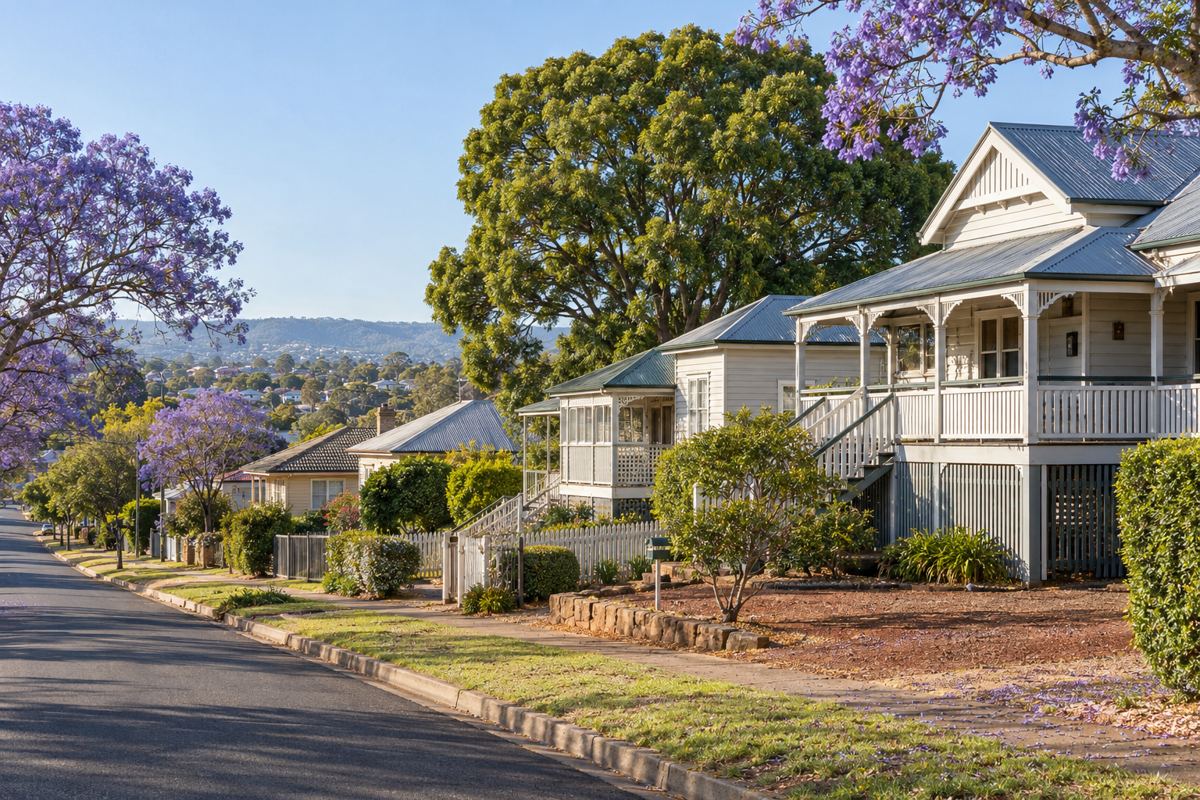
Suburbs and towns covered:
What happens on a Toowoomba restump
Six steps. The first three happen before anyone walks under the house with a jack, and all three run on paper.
Photos, the suburb and a look underneath
What the house is doing inside, what it sits on, and whether the ground under it is red loam or black clay. A subfloor inspection with a torch, a probe and a long level finds which stumps have gone, whether termites have been through, and whether the bearers and joists above are still sound. A price range follows.
Quote, contract and Home Warranty
A written quote naming the number of stumps, the stump type, the levelling, any bearer or joist work, and the approval. Over $3,300 it needs a written, dated and signed contract: Level 1 from $3,301 to $19,999 with a deposit capped at 10 per cent, Level 2 from $20,000 with a 5 per cent cap and the Consumer Building Guide before you sign. The builder pays the Queensland Home Warranty Scheme premium within 10 business days of contract and before work starts; ask for the QBCC insurance notice.
Building approval, overlays and services
A licensed certifier, council's own Total Range Certification team or a private one, decides whether the job is accepted development or needs a building development permit, and checks the overlays on the lot. A geotechnical engineer may be asked to test the soil and design the footings. If the digging goes over or near a sewer, water or stormwater main, a council application goes in first.
Jack, dig, set
Battens or lattice come off. The house is lifted a few millimetres at a time on hydraulic jacks, old stumps are cut out or pulled, new holes are dug to the depth the approved drawings call for, and concrete or galvanised steel stumps are set plumb on a string line with ant caps on top.
Level and pack
A laser level runs the bearers back to true. Steel shims or adjustable heads take up the last few millimetres. Rotted or termite-eaten bearers and joists found on the way are replaced while the floor is accessible, which under a high-set house is the easy part.
Termite notice, drainage, final inspection
The ground under the house is graded so storm water runs out rather than in, downpipes are checked, a termite management notice goes in the meter box as the building code requires, battens go back on, and the certifier's final inspection, the last of the mandatory footings, frame and final stages, closes the approval.
One permit, one licence register, two contract levels
Restumping in Queensland is building work. Section 5 of the Building Act 1975 counts building, repairing, altering, underpinning or moving a building, and any excavation or filling that may affect its stability. Building approval comes from a licensed building certifier, and in Toowoomba that can be council's own certification team, on 4688 6828 with a duty certifier at the Toowoomba Service Centre on Tuesdays and Thursdays from 9 to 4.30, or a private certifier. Replacing a handful of stumps may be accepted development; Logan City Council's fact sheet puts the line at 20 per cent of the structural components of the same type, and says raising the height of a dwelling always needs approval. A full restump, underpinning or any house raise needs a building development permit. The certifier decides.
Over $3,300 the builder needs a QBCC licence in a class that covers the work, which for a house is Builder Low Rise or higher; underpinning also sits under the Foundation work trade class. The old repairs-and-maintenance class is capped at $10,000 and cannot alter a loadbearing member, so it does not cover restumping. Unlicensed building work carries 250, 300 or 350 penalty units under section 42 of the QBCC Act, which at $172.70 a unit from 1 July 2026 is $43,175, $51,810 or $60,445, and an unlicensed contractor cannot claim more than the reasonable cost of materials and labour. An owner can do up to $11,000 on their own property without a permit; above that it is an owner-builder permit, a course, no Home Warranty cover and a notice on the title for seven years.
Over $3,300 the Queensland Home Warranty Scheme applies, with structural defects covered for six years and six months from contract and a standard maximum of $200,000, and a cooling-off notice goes with the contract. Around that sit council's rules: the heritage and neighbourhood character overlays in the Toowoomba Regional Planning Scheme 2012, where removal or pulling down of a mapped place is generally impact assessable and raising or enclosing a house can be; the flood hazard overlay and its floor levels; the landslide hazard overlay on the escarpment; and a council application before building over or near a sewer, water or stormwater main. Council fees change each year; ask for the current figure.
Heritage, character, flood and landslide overlays in Toowoomba
What a restumper cannot fix
A restumper cannot make black clay stop moving, cannot stop red soil washing out where a downpipe has been dumping storm water on it for twenty years, and cannot sign off the building approval, because that is the certifier's job. A restumper cannot tell you from the street whether the bearers are sound, cannot stop termites coming back to a house with no management system, cannot say whether your house is a mapped heritage or character place, and cannot promise a 1970s brick veneer will stop cracking, because that is footings and an engineer, not stumps. Those belong to the drainer, the certifier, the pest controller, council's planning team and the engineer, in that order.
Check the current rules before you rely on this
This page summarises how restumping is approved and regulated in Queensland for Toowoomba property owners. It describes the rules in general terms as they stood in October 2026. Standards, forms, thresholds and fines change.
The authoritative sources are Building Act 1975 (Queensland), Toowoomba Regional Council, building certifiers, Logan City Council fact sheet, building approval requirements for domestic work, QBCC, when you need a licence, QBCC, domestic building contract levels and QBCC, what is the Queensland Home Warranty Scheme. Where anything here differs from those sources, they are right and we are not.
We are not building certifiers, engineers, planners or lawyers. For what applies to your house, ask a licensed building certifier or ring Toowoomba Regional Council on 131 872.
Accurate at the time of writing, October 2026. Always check the source before relying on it.
What moves the price of a restump
Restumping is priced per stump and then adjusted for everything that makes a stump harder to get to or more likely to be joined by other work. In Toowoomba the ground under the house and the state of the bearers move the number more than the size of the house does, and whether the house is high-set or low-set comes a close third.
| Factor | Why it matters |
|---|---|
| Stump count | A small 1920s Queenslander on a tight stump grid can carry more stumps than a bigger post-war house on bearers at wider centres. The count sets the base. |
| Clearance | A low-set timber home 400 mm off the ground in Harristown is dug by hand lying down. A high-set Queenslander in East Toowoomba is walked under, which is cheaper per stump, but the stumps are longer and the house is heavier to hold. |
| Stump type | Precast concrete is the common choice. Galvanised adjustable steel costs more per stump but can be relevelled later with a spanner, which matters in reactive clay. |
| Ground | Red ferrosol on the Range digs easily and drains. Black vertosol on the Downs is hard when dry, heavy when wet, and the most reactive class there is. The soil test sets how deep the holes go and how wide the pads are. |
| Bearers and joists | Rotted or termite-eaten timber above the stumps is replaced while the floor is up. On a house with a blocked subfloor and no termite management it is often the bigger line. |
| Approval and engineering | The certifier's fee for the building development permit and the three inspections, a soil test and an engineer's footing design where the certifier asks for one, and any council application for building over or near a service. Council fees change each year; ask for the current figure. |
| Access | Can a small excavator get down the side between the house and the fence, or does every barrow of red spoil go out through the gate by hand to a trailer on the street. |
| Drainage and termites | Regrading the ground under the house, an agricultural drain on the high side, downpipes to stormwater, and a termite management system with the notice in the meter box, so the new stumps do not meet what the old ones did. |
When you compare quotes, check whether each one names the number of stumps and their type, says who is applying for the building approval, says what happens if bearers are found to be rotten, states the contract level and deposit, and includes the Home Warranty premium.
Things Toowoomba home owners ask
Do I need building approval to restump a house in Toowoomba?
Usually, for a full restump. Restumping, underpinning and raising a house are building work under section 5 of the Building Act 1975, and a full restump or any house raise is assessable work that needs a building development permit from a licensed building certifier. Replacing a few stumps may be accepted development: Logan City Council's fact sheet puts the line at 20 per cent of the structural components of the same type. The certifier decides. Toowoomba Regional Council certifies through its own team as well as private certifiers.
Does the restumper need a QBCC licence?
Yes, once the job is worth more than $3,300 including labour, materials and GST, and almost every restump is. The licence has to be in a class that covers the work, which for a house is Builder Low Rise or higher; underpinning also sits under the Foundation work trade class. There is no restumping-specific class. Ask for the licence number with the quote and check it on the QBCC licensee register before you sign anything.
How do I know if my house needs restumping or just relevelling?
By what the stumps look like, not what the floor feels like. A sloping floor, sticking doors and cracks over the door frames tell you the house has moved. Whether it needs new stumps or can be jacked back up on the ones it has depends on whether those stumps are rotten, termite-eaten, leaning or still sound. A subfloor inspection with a torch and a probe answers that in an hour, and under a high-set Queenslander it is an easy hour.
Why do Toowoomba houses go through stumps?
The ground, the seasons and the termites. On the Range the houses sit on red volcanic ferrosol that drains well and digs easily; out on the Downs they sit on black cracking vertosol that swells after summer storms and opens wide cracks in a dry winter. QBCC says termites are a problem throughout Queensland, and a hardwood stump that went in under a Newtown Queenslander in the 1920s has had a century of wet summers, dry winters and termites at ground level.
What does restumping cost in Toowoomba?
It depends on how many stumps, how high the house sits, what the new stumps are made of, whether the ground is red loam or black clay, how far the spoil has to be carried, and whether bearers and joists need replacing while the floor is up. Work over $3,300 needs a written contract and Home Warranty cover; from $20,000 it is a Level 2 contract with a 5 per cent deposit cap. The cost guide goes through what moves the price and what a quote should name.
Can the house be raised at the same time?
Often, and in Toowoomba it is a common reason to call. A high-set or low-set Queenslander can be lifted for a build-under or to get the floor above a flood level while the stumps are being replaced. Any house raise is assessable building work and needs a building development permit, a structural engineer, usually a geotechnical report, and a licensed builder. The Queensland Development Code sets a height limit; the certifier confirms it. Ask council's planning team before you raise or enclose.
Which suburbs and towns do you cover?
The whole of the Toowoomba region: Toowoomba City, East Toowoomba, Newtown, North and South Toowoomba, Harristown, Rangeville, Kearneys Spring, Darling Heights, Wilsonton, Rockville, Harlaxton, Mount Lofty, Prince Henry Heights, Centenary Heights, Middle Ridge, Drayton and Glenvale, plus Highfields, Westbrook, Gowrie Junction, Cabarlah, Crows Nest, Oakey, Pittsworth, Cambooya, Greenmount and Withcott. The town pages cover the ground and the housing in each part.
Does a restumped house need planning approval as well?
The building development permit covers the work itself. Planning comes into it where the house is a mapped Local or State Heritage Place or sits in a Neighbourhood Character area under the Toowoomba Regional Planning Scheme 2012, and Toowoomba does not use a blanket pre-1946 rule. Like-for-like restumping that does not change the house's appearance or height is usually outside those codes, but raising the house or enclosing underneath can be assessable. Ask council's planning team rather than assume.
Send a few photos and a suburb
The worst room, the outside of the house, and if you can get under the floor, a stump or two. That is usually enough for a price range before anyone drives out.