What a full restump covers
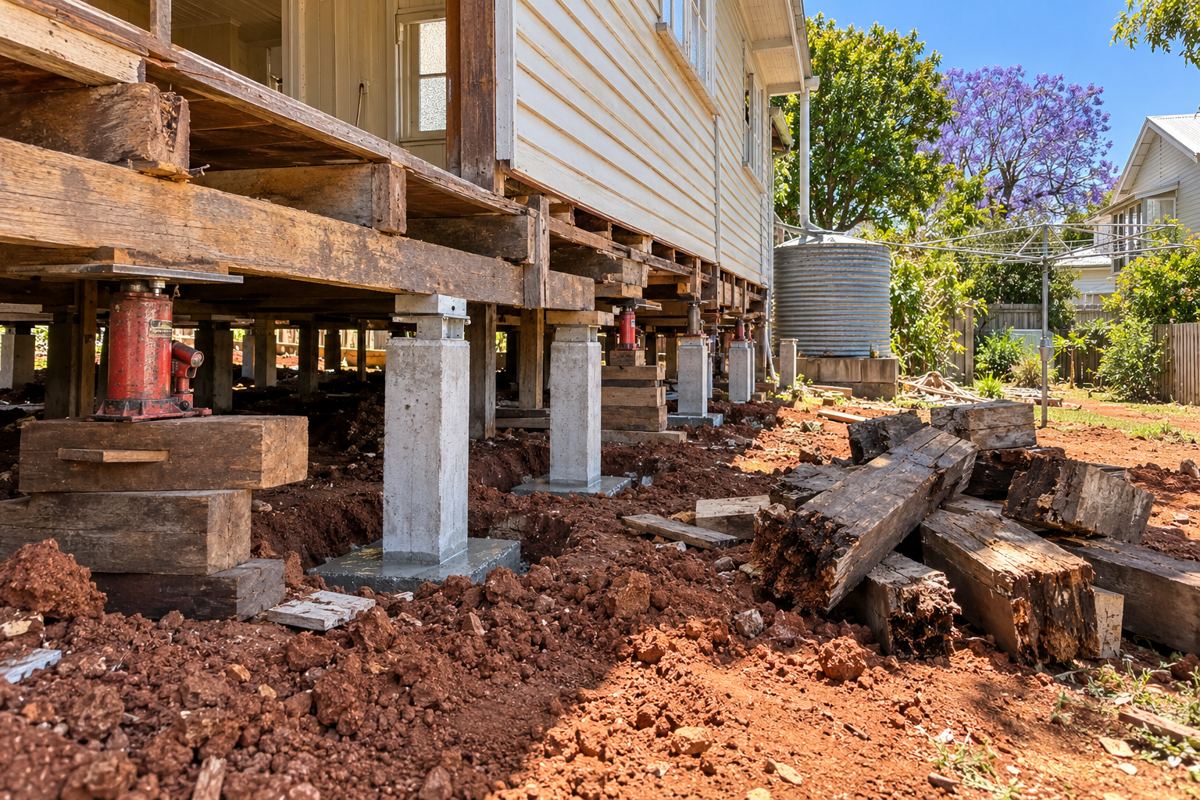
A full restump takes out every stump under the house, not only the ones that have obviously failed, and sets the floor to one level on the new ones as they go in. The house is carried on hydraulic jacks a few millimetres at a time, each old stump is cut out and dug up, a new hole goes down to firm ground, a precast concrete stump or an adjustable galvanised steel stump is set plumb to a string line, an ant cap goes on, the bearer is packed to a laser level, and the battens, lattice or base cladding go back. It also covers the paperwork. In Queensland that means a building development permit from a licensed building certifier, because repairing, altering or underpinning a building is building work under section 5 of the Building Act 1975, and a full restump replaces every footing the house has.
What it does not automatically cover is the hardwood above the stumps. Under a 1920s Queenslander in Newtown or a post-war cottage in Harristown, the bearers and joists have had the same decades over damp clay as the stumps, and where a stump has rotted the bearer sitting on it has often softened too. That work has its own page, bearer and joist repairs, and a quote worth signing says how it is priced before the first stump comes out.
Why the whole house rather than the bad corner
Stumps of one age in one piece of ground fail together. If the eight stumps along the shaded southern wall of a high-set Queenslander in East Toowoomba have gone at the ground line, the rest are the same hardwood at the same depth with the same number of summers behind them, and they will follow. Doing eight now and twenty in three years means two approvals, two set-ups, two lots of jacking and a floor levelled twice to two different lines. Where the inspection finds most of the stumps sound and only a wet corner gone, a partial restump is the better job, and Logan City Council's building approval fact sheet puts the line between a repair and a restump at 20% of the structural components of the same type. The subfloor inspection decides which job it is, not the quote.
Toowoomba has a lot of houses on stumps to decide about. The ABS counted 73,881 dwellings across the region at the 2021 census, 82.7% of them separate houses. Newtown was subdivided in 1865, East Toowoomba grew up around Queens Park from 1869, Harristown was cut up in 1902 and 1910, and the Caledonian Estate east of the CBD was built in timber Queenslander style. A large share of that stock is hardwood on hardwood stumps older than anyone now living in the house.
| Where the house sits | What the ground does | What it means under the floor |
|---|---|---|
| The Range and the older city: Newtown, East Toowoomba, Mount Lofty, Rangeville | Red ferrosol, a well-drained volcanic soil formed on the basalts of the Main Range Volcanics. Takes water readily, holds it in summer. | Hardwood rots at the ground line where damp soil meets air. Digging is easy, holes stand up, and concrete or steel sits well once it reaches firm ground. |
| The Downs side: Harristown, Glenvale, Drayton, Wilsonton and west | Black cracking vertosol, the most common soil in Queensland. Swells after summer storms and opens wide cracks in a dry winter. | Stumps founded in the layer that moves ride up and down with the seasons. Deeper holes, wider pads and drainage settle it down; steel lets a corner be wound back later. |
| The escarpment and the eastern slopes: Prince Henry Heights, Withcott side, the gullies | Basalt close to the surface, shallow and variable soils, mapped slope instability on the eastern slopes. | Hard digging, depth to rock that changes across one house, and a planning question where the lot is in the landslide hazard overlay. |
| Surrounding towns: Highfields, Crows Nest, Oakey, Pittsworth, Cambooya | A mix of red loam and black clay depending on which side of the Range the town sits. | Same choices as the city; the soil test on the block decides the depth and the pad. |
None of that tells you the site class of a particular block. Builder guidance cited by one Queensland builder puts black and dark brown Darling Downs soils and parts of Toowoomba in the most reactive class and red and brown silty soils in a moderate one, but that is general guidance, not a survey of your street. The soil test classifies the site, and on a full restump the builder and the certifier agree how deep the holes go from what the first few show. The soils guide goes through it.
What has to happen before the jacks go in
- Subfloor inspection. Every stump is probed at the ground line, checked for plumb and for moisture. Bearers, joists, the framing under the bathroom and laundry and any termite mud tubes are noted. Ask for photographs with the report, especially if the house is a rental and you are not the one on site.
- Licence checked. Building work over $3,300 in labour, materials and GST needs a QBCC licence, and a full restump is well over that. The class has to cover the work: for a house that is Builder Low Rise or higher. The old repairs-and-maintenance class is capped at $10,000 and cannot alter a loadbearing member or add a foundation, so it does not cover restumping. Check the number on the QBCC licensee register before you sign.
- Written contract. From $3,301 to $19,999 a Level 1 contract; at $20,000 or more a Level 2 contract with a start date, a fixed price or a method of working it out, the statutory warranties and the Consumer Building Guide handed over before signing. Both are written, dated and signed before work starts, per QBCC's contract rules. The deposit is capped at 10% on a Level 1 contract and 5% on a Level 2, and a cooling-off notice applies over $3,300.
- Home Warranty Scheme. Residential work over $3,300 is covered by the Queensland Home Warranty Scheme. The builder collects the premium through the contract price and pays it within 10 business days of signing and before work starts. Ask for the QBCC insurance notice; structural defects are covered for 6 years 6 months from the contract date.
- Building approval. A full restump is assessable building work, so a licensed building certifier issues the building development permit. Toowoomba Regional Council still certifies through its own team, Total Range Certification, alongside private certifiers; the council certification line is 4688 6828 and a duty certifier sits at the Toowoomba Service Centre on Tuesdays and Thursdays from 9 to 4.30. Mandatory inspections are footings, frame and final, and the certifier may ask for a geotechnical engineer to test the soil and design the footings.
- Overlays and services. The certifier checks the heritage, neighbourhood character, flood hazard and landslide hazard overlays at maps.tr.qld.gov.au. A like-for-like restump that does not change the height or the look of the house is usually outside the heritage and character codes, but ask council's planning team before you raise or enclose. Building over or near a sewer, water or stormwater main needs a separate council application.
On the day
Battens or lattice come off along the side being worked. Jacks go under the bearer either side of the first stump and take the load. The old stump is cut off and dug out. The new hole goes to firm ground, usually deeper than the old one: on the red soil of the Range that is a clean hole that stands up, on the black clay of the Downs it is a wider pad and, after a summer storm, a pump in the hole, and on the shallow ground near the escarpment it is a crowbar and a hole that is deeper on one side of the house than the other. A precast concrete stump goes in on a sole plate, or a galvanised steel stump is set on a poured pad. It is plumbed to the string line, the ant cap goes on, the bearer comes down onto it, the hole is backfilled and rammed. Then the next one.
When the stumps are in, the laser goes up. Every bearer is brought to one line with galvanised steel packers, or on adjustable steel stumps by winding the head. Rotted bearers and joists found along the way come out and new hardwood goes in. Vents and battens are refitted, the ground under the house is graded to fall to the edges rather than the middle, and the base cladding goes back. The certifier inspects the footings before they are backfilled and the finished job at the end, and the approval is closed off with a final inspection certificate.
A low-set timber home is typically a week to ten days on site; a high-set Queenslander has more stumps but more room to work. A crew works a bearer at a time and lifts no more than a few millimetres at any point so VJ boards, plaster and any brick skirt are not shocked.
What Toowoomba adds
Summer wet, winter dry. The Bureau's long Toowoomba city record shows a mean of 952.4 mm a year with January the wettest month at 132.1 mm; the airport, lower and further west, records 740.1 mm with December the wettest at 103.5 mm. On the black clay that pattern means the ground swells through the storm season and shrinks through a dry winter, so a house relevelled in March on shallow stumps can be out again by September. On the red soil it means a damp subfloor for a few months and a dry one for the rest, which is enough to rot hardwood at the ground line over fifty years.
Termites. QBCC describes termites as a problem throughout Queensland, the building code requires a termite management notice in the meter box, and the NCC Queensland variation requires termite management with a 50-year design life. Ant caps on every new stump are standard, and any bearer showing galleries is replaced rather than patched.
Heritage and character. Toowoomba has 64 places on the Queensland Heritage Register, 29 of them in the City, 10 in East Toowoomba and 7 in Newtown, and the planning scheme's Heritage overlay and Neighbourhood Character overlay apply to listed places and mapped streetscape areas. There is no blanket pre-1946 rule here. Our position is that a like-for-like restump that leaves the height and the street view unchanged is usually outside those codes, but raising, lowering or enclosing under the house can be assessable. Ask council's planning team on 131 872 or at [email protected] before you change anything visible.
Unlicensed work. Under section 42 of the QBCC Act unlicensed building work attracts 250, 300 or 350 penalty units, which at $172.70 a unit from 1 July 2026 is $43,175, $51,810 and $60,445. An unlicensed person is also not entitled to be paid beyond the reasonable cost of materials and labour. On your own property you can do up to $11,000 of work without a permit; above that an owner-builder permit, a course, no Home Warranty cover and a notice on the title for 7 years. For a full restump, that is a strong argument for a licensed builder.
What a restump cannot fix
A restump cannot stop a floor moving if the stumps were never the problem. A brick veneer on a strip footing cracking on Downs clay is a footing problem, which is an engineer and underpinning. A restump cannot dry a subfloor that sits lower than the yard and fills in every storm; the drainage has to be fixed or the new stumps stand in the same water the old ones rotted in. It cannot make a soft bearer sound again, which is why the quote has to price that before the battens come off. It cannot tell you whether a heritage, character, flood or landslide overlay applies to your block; the certifier and council do that. And it cannot be done by a repairs-and-maintenance licensee, whatever the price.
Check the current rules before you rely on this
This page describes how a full house restump is approved and carried out in Toowoomba and the Darling Downs. It describes the rules in general terms as they stood in October 2026. Standards, forms, thresholds and fines change.
The authoritative sources are Building Act 1975 (Queensland), Logan City Council fact sheet, building approval requirements for domestic work, QBCC, when you need a licence, QBCC, Builder Low Rise licence class, QBCC, domestic building contract levels and Toowoomba Regional Council, building certifiers. Where anything here differs from those sources, they are right and we are not.
We are not building certifiers, engineers, planners or lawyers. For what applies to your house, ask a licensed building certifier or ring Toowoomba Regional Council on 131 872.
Accurate at the time of writing, October 2026. Always check the source before relying on it.